Bench-Bar-Media Program: “Immigration and Justice: The U.S. Legal System Most Americans Never See.”
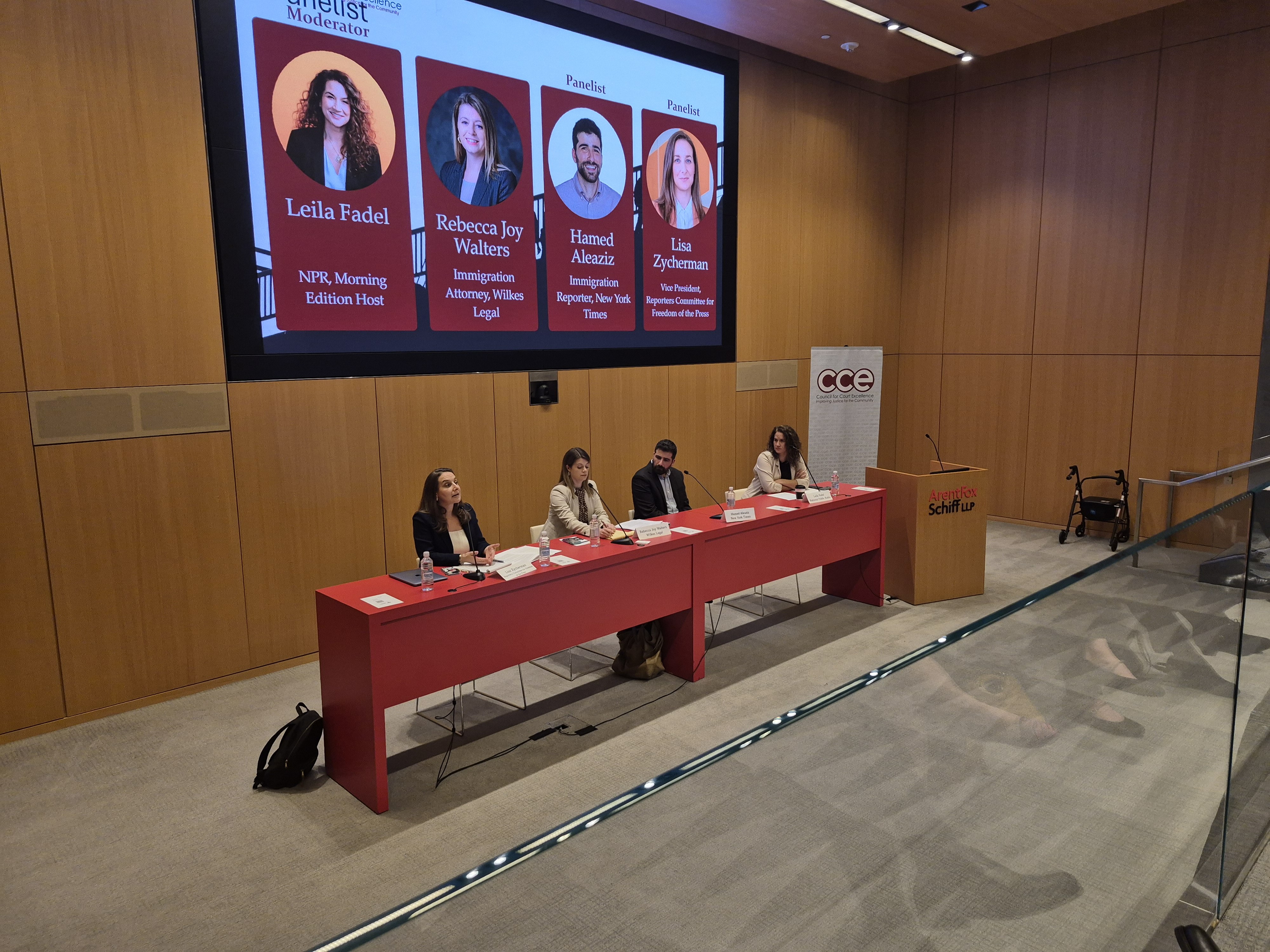
On Tuesday, September 30, 2025, the Council for Court Excellence hosted our 21st Bench-Bar-Media dialogue event, titled “Immigration and Justice: The U.S. Legal System Most Americans Never See.” The event drew an audience eager to understand the realities of the U.S. immigration court system.
Leila Fadel, experienced National Public Radio (NPR) Host of Morning Edition and Up First, moderated a successful discussion of expert voices across journalism, legal advocacy, and judicial administration.
The panel included:
- Hamed Aleaziz-- DHS and Immigration Reporter at the New York Times.
- Rebecca Joy Walters-- Senior Immigration Attorney at Wilkes Legal, former Assistant Chief Immigration Judge with the Executive Office for Immigration Review.
- Lisa Zycherman-- Vice President of Legal Programs at Reporters Committee for Freedom of the Press.
These panelists are each uniquely situated to unpack the intricacies of immigration enforcement operations, the pressure facing immigration courts and judges, and publictrust in the immigration court system. The audience learned about the basic operations of the immigration court system. For example, the panelist noted that immigration courts are administrative law courts, and immigration judges are federal employees of the U.S. Department of Justice. This means the President can remove and reappoint judges, which can lead to significant turnover as administrations change.
Walters explained how this hovering threat of removing judges has potential to undermine the judicial process. Judges may be hesitant to make decisions that could be politically disfavored by the current presidential administration for fear of losing their jobs. Walters shared her experience of being fired alongside other chief judges, triggering a domino effect of terminations. This dynamicpotentially undermines principles of fairness and due process by fostering a fear of reprisal as judges make decisions in court.
Zycherman emphasized the importance of media freedom in the courts to ensure accountability. She explained that immigration court records are not as easily accessible as other court records,and how the restricted visibility of court proceedings can affect the public’s outlook, trust, and understanding of immigration policy. She believes that journalists should have priority seating in immigration courts because they are the “eyes and ears” of the public, and it should be prohibited to remove journalists from the courts. Zycherman also informed the audience about federal rules that restrict electronic access to immigration court records, leaving reporters to retrieve unredacted copies in person, which serves as another barrier to accessing public information. Aleazizshared his own first-hand insights into the experience of being an immigration reporter, including having difficulty locating case files for important stories. He explains how the opacity of immigration courts leaves the public insufficiently informed about immigration proceedings and their outcomes.
The event concluded with an engaging Q&A session, during which attendees asked thought-provoking questions about how to support journalists covering immigration issues and restore public trust in the court system. One attendee asked, “Are there any proactive reporting strategies, campaigns, or communication tactics that are currently being employed to represent issues of immigration and justice at this time?” Aleaziz responded that some groups are trying to address these issues by telling the stories of individuals affected by the immigration policies of the current administration; however, it may be difficult at times to report on these issues effectively.
The panelists all emphasized the urgent need for greater accountability, transparency, and reform in the immigration court system. The Council for Court Excellence extends its deepest gratitude to Leila Fadel, Hamed Aleaziz, Rebecca Joy Walters, Lisa Zycherman, and all the participants who brought their insights and curiosity to the discussion. Thank you to ArentFox Schiff for hosting the event in their wonderful space. To support events at the intersection of law, media, and public interest, donate to support our work.
Stay in the Know with Our Quarterly Newsletter
Receive updates, event invitations, information about new publications, and more.

Join CCE for "Maintaining the Rule of Law: How Federal Courts in D.C. Manage Demanding Dockets," a Bench-Bar-Media Dialogue event
300+ Legal, Business, and Community Leaders Join CCE in Urging Senate to Fully Fund DC Courts